
Seneca County Court Records After Arrest
The arrest-to-court path in Seneca County usually runs from arrest, booking or intake at the correctional facility, arraignment, prosecution review, a formal court case, future appearances, and final disposition. A sheriff press release or inmate record may describe arrest allegations. The court record is the better place to find the charges that were actually filed, amended, reduced, dismissed, or resolved.
The Seneca County District Attorney prosecutes crimes and offenses cognizable by the county courts. Research from the official county directory names John Nabinger as District Attorney. For custody and booking details, use the sheriff app and Seneca County jail inmate records. For booking photos and New York booking-photo limits, use the Seneca County jail mugshots page. For court records after an arrest, start with the official court system.
Find Court Records After a Seneca County Arrest
The official New York State Unified Court System WebCriminal portal is the main online case-search channel located in the research. WebCrims offers search paths by case identifier, defendant, and court calendar. The official WebCrims information page explains that it provides information on criminal cases with future appearance dates in selected New York criminal courts. It is not a jail roster and does not confirm custody.
The WebCrims portal is the official court-search source captured for Seneca County court records after arrest.
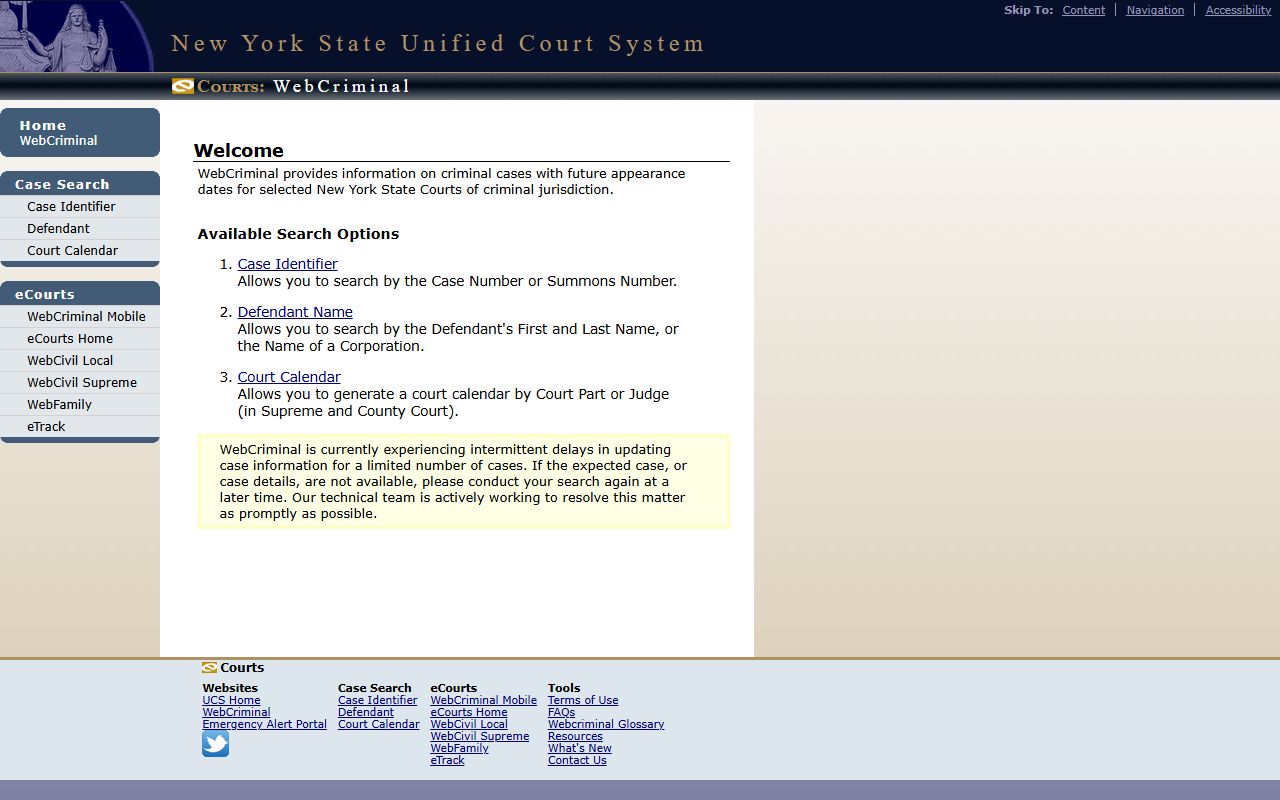
The screenshot reinforces the split between court case lookup and jail custody lookup, which use different official systems.
- Open the WebCrims portal.
- Search by defendant name when no docket or summons number is known.
- Use a case identifier when the court, attorney, or paperwork provides one.
- Use court calendar search when the next appearance date or court is known.
- If no result appears, contact the specific town, village, or county court because the case may be too new, closed, sealed, or outside the portal's current display.
| Search Path | Type | Notes |
|---|---|---|
| Case Identifier | Case or summons number | Best when paperwork already lists the identifier. |
| Defendant | Name search | Use county or court filters if the portal prompts for them. |
| Court Calendar | Calendar search | Useful for future appearances and daily court lists. |
| County / Court | Dropdown or filter | Choose Seneca County or the specific local court when prompted. |
Charges Filed After a Jail Arrest
Booking starts the jail side of the record. A charging document starts or frames the court side. In Seneca County, the District Attorney can file, amend, reduce, dismiss, or supersede charges after reviewing the arrest. That is why a jail roster charge and a court charge may not match word for word.
| Document | What It Means | Common Use |
|---|---|---|
| Complaint | An accusatory document often used at the beginning of a criminal case. | Early criminal court filings after arrest. |
| Information | A formal local criminal court accusatory instrument when legally sufficient. | Misdemeanor or offense prosecution in local court. |
| Indictment | A grand-jury charging document. | Felony prosecution in County Court or Supreme Court. |
Disposition is the final result, such as plea, conviction, dismissal, acquittal, adjournment in contemplation of dismissal, or sentencing. WebCrims may show current or future court information, but old, sealed, or closed matters may require the court clerk or another official channel.
Seneca County Charge Status Records
Charge status can change after a Seneca County arrest. A person can be booked on one allegation, arraigned on a related charge, and later face a different filed charge after prosecutor review. The court record is the place to check the current status because the prosecutor and court control the filed case.
| Status | What It Means |
|---|---|
| Pending | The charge remains active and the case has not reached a final disposition. |
| Amended | The filed charge or wording changed after review or court action. |
| Reduced | The charge was lowered to a lesser offense or different count. |
| Dismissed | The charge was terminated by the court or prosecution and is no longer pending. |
| Disposed | The case or count reached a final outcome such as plea, conviction, dismissal, or sentence. |
Seneca County Prosecutor Records
The Seneca County District Attorney page states that the office prosecutes all crimes and offenses cognizable by the county courts. The official 2026 county directory lists the office at 44 West Williams Street in Waterloo and gives the public phone number. The DA page also identifies Victim/Witness and Domestic Violence Director contact through the same public number.
Seneca County District Attorney
44 West Williams Street
Waterloo, NY 13165
(315) 539-1300
Fax: (315) 539-0531
The District Attorney is not a general custody search office. Use the DA context to understand prosecution, victim-witness contact, traffic or DWI policy, and charging decisions. Use courts for filed case records and use the sheriff for jail custody or booking records.
Seneca County Local Court Records
Seneca County criminal matters can move through town, village, county, or other New York courts depending on the charge and stage. The official county Magistrates page lists town and village court contacts and session times. That local court layer matters because bench warrants, misdemeanors, violations, and early appearances often sit with a lower court rather than a single countywide case desk.
WebCrims should be checked first for searchable future appearances, but the clerk of the court where the case was heard may be necessary when a case is too new, too old, sealed, closed, or outside the portal display. A sheriff booking record can help identify the arrest date and agency, but it should not be treated as the final court charge record.
Bail and Release After Arrest
Release after a Seneca County arrest depends on the court's order and any other holds. New York permits several release outcomes, including recognizance release, non-monetary conditions, cash bail, bond or surety arrangements, remand, and holds. The sheriff app announcement says users can make payments through the app to post bail, and the jail visitation material references a bail bond release lobby kiosk for commissary deposits.
| Release Type | How It Works |
|---|---|
| Recognizance release | The defendant is released on a promise to return to court. |
| Non-monetary conditions | The court sets conditions other than money, such as supervision or orders to appear. |
| Cash bail | Money is paid to secure the person's return to court when bail is legally ordered. |
| Surety bond | A bail agent or surety secures release when allowed by law and court order. |
| Remand or hold | The person stays in custody because release is not authorized or another agency hold blocks release. |
A parole hold, state-ready transfer, federal detainer, ICE matter, or warrant from another jurisdiction can block release even when bail is posted on one case. Confirm the full custody status before assuming a court payment ends detention.
Warrants and Seneca County Arrest Records
No full official Seneca County active-warrant web search was located during the research. The sheriff app listings advertise Most Wanted, but that is not the same as a complete warrant database. A warrant can still lead to booking at the Seneca County Correctional Facility, and the court that issued the warrant may hold the key case information.
- Arrest warrant: court authorization to arrest on a criminal matter.
- Bench warrant: often issued after failing to appear or violating a court order.
- Search warrant: authorizes a search and is not a custody roster.
- Fugitive warrant: tied to another jurisdiction or extradition matter.
- Parole warrant: tied to parole supervision and may create a jail hold.
Charges vs Convictions
A charge is an accusation filed in court. A conviction is a final finding through plea or verdict. Court records after a jail arrest can show both stages, but the terms should not be mixed. The existence of a charge does not mean the person was convicted.
| Point | Charge | Conviction |
|---|---|---|
| Stage | Accusation after arrest and filing | Final result after plea or verdict |
| Meaning | The case or count is alleged or pending unless disposed | The court found guilt or accepted a guilty plea |
| Where to verify | WebCrims, court clerk, charging document | Court disposition, sentence record, official clerk record |
Sealed Court Records After Arrest
New York uses sealing rules for many criminal records rather than a broad, simple public expungement model. Criminal Procedure Law section 160.50 requires sealing when a criminal action terminates in favor of the accused, subject to statutory exceptions. Once sealed, ordinary public access to the court or arrest record can be restricted.
| Record Access Point | Sealed | Expunged |
|---|---|---|
| Public visibility | Restricted from ordinary public access | Not the general New York model for most cases |
| Agency access | Limited access may remain under law | Depends on the specific statute, if any |
| Common trigger | Termination in favor of the accused under CPL 160.50 | Only when a specific law provides that remedy |
FOIL does not override sealed criminal records. Youthful-offender, juvenile, privacy, safety, and law-enforcement exemptions can also limit disclosure. A court clerk, attorney, or official sealing order is more reliable than a casual web search when the record may be restricted.
Public Access Limits After Arrest
FOIL gives a request path for government records, but it is not unlimited. Public Officers Law sections 87 and 89 set access and procedure while preserving exemptions. Booking photographs have a specific New York limit in FOIL Article 6 when public release does not serve a law-enforcement purpose or is otherwise barred. Juvenile matters, sealed cases, active investigations, and privacy-sensitive material may be withheld or redacted.
Important: Do not use casual court or jail lookups for employment, tenant, insurance, credit, or other FCRA-covered screening.